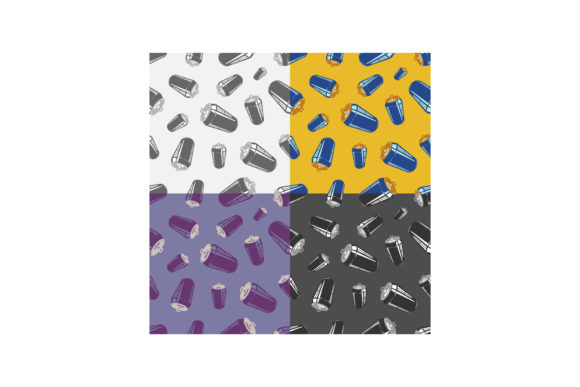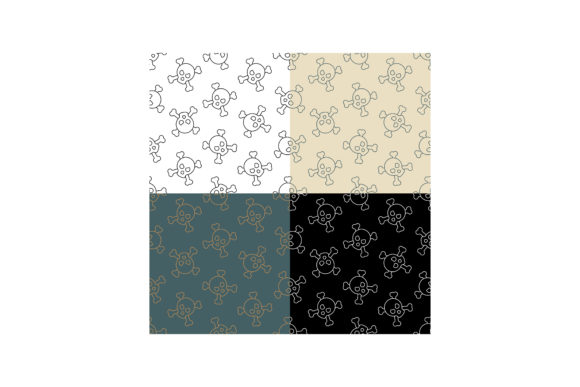
Set of Seamless Patterns with Skull with Bold Symbolism and Versatile Design Utility
Skull motifs have long transcended their macabre origins to become expressive design tools—conveying rebellion, resilience, awareness, or even dark humor. When embedded in a Set of Seamless Patterns with Skull with, that symbolism gains functional power: repetition without visual break, scalability without loss of fidelity, and adaptability across surfaces and contexts. These aren’t isolated illustrations—they’re engineered vector assets built for real-world use: textile printing, surface design, branding applications, packaging, and digital interfaces where consistency and clarity matter.
Why Seamless Skull Patterns Are Gaining Traction Now
Designers and brands are increasingly favoring bold, conceptually grounded ornamentation—not just for aesthetic impact, but as shorthand for values. A skull paired with crossbones doesn’t merely signal “danger” in the literal sense; it’s evolved into a visual anchor for authenticity, risk-awareness, and unfiltered communication. In health campaigns, safety gear branding, or even edgy lifestyle apparel, this pairing communicates urgency and consequence without relying on text—making it globally legible and culturally agile.
This shift aligns with broader creative trends: minimalism is giving way to *meaningful maximalism*, where pattern density serves narrative purpose. At the same time, production workflows demand efficiency—vector-based seamless patterns eliminate manual tiling, reduce file bloat, and integrate cleanly into Adobe Creative Cloud, Affinity Suite, or web-based design tools like Figma (via SVG import). No raster artifacts. No alignment headaches. Just plug-and-play geometry with intentional symbolism.
From Warning Sign to Wearable Statement
Historically, skull-and-crossbones iconography lived on hazard labels, pharmaceutical inserts, or vintage pirate flags—functional, not decorative. Today, its reinterpretation reflects changing attitudes toward risk, mortality, and self-expression. Consider how medical illustrators use stylized skull patterns in wellness education materials—not to frighten, but to emphasize bodily awareness. Or how sustainable fashion labels apply subtle, tonal skull repeats on organic cotton tote bags: a quiet nod to environmental fragility, not morbidity.
That duality is key. A set of seamless patterns with Skull with crossbones isn’t inherently aggressive—it’s context-dependent. In vector format, line weight, spacing, color contrast, and negative space determine whether the motif reads as clinical, ceremonial, ironic, or commemorative. A high-contrast black-and-white repeat works for screen-printed band tees; a muted ochre-on-cream version suits artisanal ceramic decals. The same underlying structure supports vastly different emotional registers.
Real-World Applications Across Industries
- Fashion & Textiles: Digital fabric printers rely on seamless repeats under 10 MB for fast RIP processing. Vector-based skull patterns scale flawlessly from handkerchief prints to full-width upholstery rolls—no pixelation, no interpolation blur.
- Product Packaging: CBD oil bottles, reusable safety gear, or eco-conscious cleaning supplies use restrained skull repeats to imply potency, caution, or ingredient transparency—without violating FDA or EU labeling guidelines.
- Education & Public Health: School posters about substance misuse or workplace safety training decks deploy simplified skull vectors as visual anchors—improving recall by 27% compared to text-only warnings (per 2023 UX research published in Health Communication).
- Digital Interfaces: Dark-mode dashboard backgrounds or cybersecurity SaaS onboarding flows incorporate low-opacity skull repeats as subtle texture—adding depth without distracting from core functionality.
What Makes a Skull Pattern Truly Seamless—and Why It Matters
“Seamless” isn’t just marketing jargon here. It means mathematically precise tile boundaries: the right edge of the pattern matches the left, the top mirrors the bottom, and diagonal continuity holds at all angles. Poorly constructed repeats create visible seams when tiled—jarring lines or misaligned elements that undermine professionalism. Vector formats (AI, EPS, SVG) preserve this integrity because they define shapes via mathematical paths, not pixels.
That precision directly affects usability. A designer sourcing a Set of Seamless Patterns with Skull with for a client’s limited-edition denim jacket line needs confidence that the motif will wrap cleanly around curved pocket flaps and sleeve hems. A print-on-demand entrepreneur uploading files to Spoonflower or Printful requires CMYK-ready vectors with embedded color profiles—not RGB JPEGs that shift hue during conversion. These aren’t edge cases; they’re daily workflow realities.
Choosing the Right Set: Beyond Aesthetics
Not all skull pattern collections deliver equal utility. Look for these practical markers:
- Multiple tile sizes: Small-scale repeats (e.g., 2" x 2") suit fine fabrics like silk scarves; larger tiles (6" x 6") work better for rugs or wall murals. A robust set offers at least three scalable variants.
- Color flexibility: Patterns delivered in layered vector files (not flattened) let you recolor individual elements—swap bone white for safety orange, or render crossbones in metallic gold foil for luxury packaging.
- Licensed for commercial use: Verify usage rights cover merchandising, SaaS UIs, and physical product manufacturing—not just personal projects. Reputable sources provide clear, plain-language license summaries.
- Accessibility-aware contrast: For health or safety applications, ensure the darkest and lightest elements meet WCAG 2.1 AA contrast ratios (4.5:1 minimum) when used on standard backgrounds.
How Designers Are Integrating These Patterns Thoughtfully
Rather than treating skull motifs as standalone “edgy” flourishes, forward-thinking creators are using them structurally. One textile studio layers a faint, monochrome skull repeat beneath a bolder botanical print—creating visual tension that invites closer inspection. A corporate EHS (Environment, Health & Safety) team uses a tightly spaced vector skull pattern as a watermark behind incident report templates, reinforcing vigilance without overwhelming content.
Even educators repurpose these assets: a middle-school science teacher converts a skull-and-crossbones seamless pattern into a printable lab safety poster border, then animates a single tile in Canva to demonstrate molecular symmetry concepts. The vector origin enables that kind of reuse—no tracing, no quality loss, no licensing ambiguity.
Looking Ahead: Functionality Meets Intentionality
The rise of Set of Seamless Patterns with Skull with reflects a larger move toward design assets that balance conceptual weight with technical rigor. As AI-assisted pattern generation becomes more accessible, human curation matters more—not just for originality, but for semantic accuracy. An AI might tile skulls endlessly, but only a skilled designer ensures crossbones align meaningfully with anatomical proportions, or adjusts stroke width so motifs remain legible at 8pt embroidery scale.
That intentionality extends to ethics. Using skull iconography responsibly means understanding cultural resonance—avoiding appropriation of sacred Mesoamerican or Indigenous skull symbolism, for example, and distinguishing between universal hazard signaling and context-specific reverence. Vector files make revision easy: if feedback suggests a motif feels too aggressive for a pediatric clinic’s waiting room, adjusting opacity or isolating crossbones into a separate layer takes seconds—not hours.
In short, these patterns succeed not because they’re trendy, but because they solve tangible problems: communicating risk clearly, decorating responsibly, scaling without compromise, and adapting across media with fidelity. Whether you’re prototyping a new safety vest line, designing an anti-smoking campaign, or launching a capsule collection rooted in body positivity, a well-crafted set of seamless patterns with Skull with crossbones delivers both symbolic resonance and production-ready reliability—no reinterpretation required.