Seamless Silver Patterns, Metallic: Precision Texture Assets for Professional Design Workflows
Seamless Silver Patterns, Metallic represent a specialized category of digital texture resources engineered for visual consistency, technical fidelity, and broad cross-disciplinary utility. Unlike generic metallic overlays or stylized gradients, these assets are constructed with mathematical precision to tile infinitely without visible seams—making them indispensable where repetition is required at scale: from product mockups and UI backgrounds to architectural visualizations and print-ready packaging layouts. Their defining characteristic isn’t just aesthetic sheen, but structural integrity across resolutions, formats, and applications.
What Makes These Patterns Technically Distinct
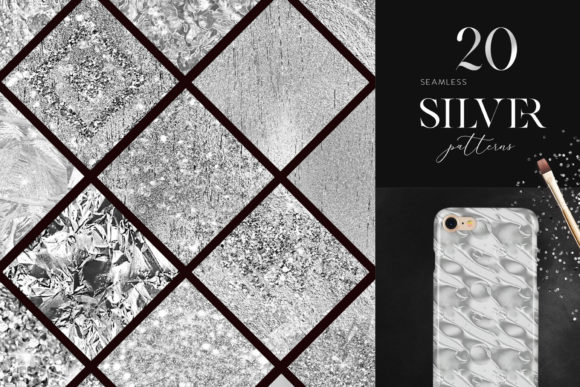
At the core of Seamless Silver Patterns, Metallic lies a rigorous production methodology. Each pattern is generated—not sampled—to ensure uniform microstructure across the entire 12×12 inch canvas. This eliminates interpolation artifacts common in resized or stretched textures. The 300 DPI resolution guarantees crisp rendering even in large-format output, such as trade show banners or luxury retail signage. More critically, every one of the 20 included .JPG files features a fully transparent background. This isn’t an afterthought; it’s foundational. Transparency enables non-destructive layering in design software (e.g., blending modes in Adobe Photoshop or masking in Figma), precise alignment over complex substrates (like wood grain or fabric scans), and dynamic color adaptation via adjustment layers or CSS filters.
The silver tonality itself avoids monochromatic flatness. Instead, each pattern exhibits subtle luminance variation—micro-contrast achieved through controlled noise distribution and directional light simulation. This mimics how real-world metallic surfaces interact with ambient illumination: brushed aluminum reflects diffusely, polished chrome yields sharp highlights, and hammered silver introduces organic irregularity. These nuances are preserved at full resolution, ensuring that zoomed-in details remain legible and physically plausible—critical for photorealistic compositing or material studies in industrial design education.
Real-World Applications Across Domains
Diverse professionals rely on Seamless Silver Patterns, Metallic not as decorative flourishes, but as functional components within larger systems. Consider how a packaging designer for a premium skincare line might use one of these patterns: applied as a subtle overlay on a matte-finish box, it conveys tactile sophistication without compromising brand minimalism. The transparency allows the underlying substrate color—say, soft dove gray—to modulate the silver’s warmth, creating depth that photographs well under studio lighting.
In UI/UX development, these patterns serve dual roles. A front-end developer may export a single tile as an SVG data URI for lightweight CSS background-repeat usage—ensuring consistent visual rhythm across responsive breakpoints. Meanwhile, a product designer prototyping a smartwatch interface could apply the pattern to simulated watch bezels, leveraging its 12-inch size to test how texture scales across varying screen densities without pixelation or tiling glitches.
Educators teaching digital fabrication find value in their reproducibility. When students laser-cut acrylic panels with engraved metallic finishes, Seamless Silver Patterns, Metallic provide reference textures for calibrating engraving depth and power settings. Researchers studying perceptual glossiness in human-computer interaction use them as controlled stimuli—knowing that variance arises only from intentional pattern differences, not compression artifacts or inconsistent alpha channels.
Hobbyists and small business owners benefit equally. A jewelry maker designing custom Shopify store banners can composite these patterns behind product photography, instantly elevating perceived craftsmanship. A ceramicist documenting glaze experiments might overlay a silver pattern onto raw clay texture photos to simulate how metallic lusters would appear post-firing—accelerating iterative design without physical prototyping.
Workflow Integration and Practical Considerations
Receiving a single .zip file containing 20 distinct .JPG files streamlines asset management without sacrificing flexibility. Designers working in non-linear pipelines—such as those alternating between Affinity Designer, Blender, and Canva—appreciate the universal .JPG format. No plugin dependencies, no proprietary encoding: just immediate drag-and-drop compatibility. The consistent 12×12 inch dimension means predictable scaling behavior. Whether importing into Illustrator as a linked asset or pasting directly into Procreate, users avoid manual resizing or aspect-ratio corrections.
That said, thoughtful implementation matters. While transparency enables versatility, it also requires attention to layer stacking order. For example, applying a Seamless Silver Pattern, Metallic over a gradient layer using Multiply blend mode produces richer tonal depth than Overlay—yet may mute contrast if the underlying layer lacks sufficient luminance range. Testing across output contexts is essential: a pattern optimized for screen brightness may appear overly stark when printed on uncoated paper due to ink absorption. Previewing at 100% zoom in CMYK mode before final export mitigates this risk.
Color management presents another nuance. Though labeled “silver,” these patterns exist in RGB space—ideal for digital delivery—but require conversion workflows for offset printing. Designers preparing for Pantone Metallics should treat them as visual guides rather than direct color matches; actual foil stamping or metallic inks involve physical pigment behavior beyond digital simulation. Still, the high-fidelity grayscale foundation provides reliable reference points for communicating intent to print vendors.
Why Size and Quality Are Non-Negotiable
The decision to deliver 12×12 inch, 300 DPI files reflects an understanding of modern production demands. Smaller dimensions—like 2000×2000 pixels—force compromises: upscaling introduces blur, tiling reveals repetition frequency too quickly, and cropping for specific aspect ratios risks losing critical texture continuity. At 12 inches square, each file contains over 4,320,000 pixels (3600×3600), granting substantial headroom for cropping, rotation, or perspective warping without degradation. This becomes especially valuable in architectural visualization, where a single pattern might wrap around curved curtain wall sections or extend across multi-story façade renderings.
“High Quality” here refers not just to resolution, but to bit-depth fidelity and noise control. These files avoid JPEG compression artifacts near high-contrast edges—a common pitfall when metallic textures contain fine linear elements like hairline scratches or etched grids. Compression was minimized during export to preserve micro-detail integrity, ensuring that halftone simulations or engraved line work retain edge sharpness. That fidelity translates directly to time savings: fewer manual touch-ups in post-production, less iteration when clients request close-up detail shots.
User-Centric Design Philosophy
Professionals rarely seek textures in isolation—they solve problems. A UX researcher validating icon visibility against textured backgrounds needs predictable contrast ratios. A textile designer adapting metallic motifs for jacquard weaving requires clean vectorizable edges. A game environment artist building a cyberpunk cityscape needs patterns that hold up under real-time shader distortion. Seamless Silver Patterns, Metallic address these implicitly through constraints: transparency supports compositing logic, fixed dimensions enable automation scripts, and the deliberate avoidance of copyright-restricted motifs (e.g., branded logos or trademarked weaves) ensures legal safety across commercial projects.
This user-centric approach extends to accessibility considerations. While metallic textures themselves aren’t semantic content, their responsible use impacts perceivability. Designers applying these patterns as subtle backgrounds behind text must verify sufficient contrast between foreground typography and the pattern’s lightest/darkest values—not just its average luminance. Tools like WebAIM’s Contrast Checker accept hex values sampled directly from the pattern’s extremes, making compliance verification tangible rather than theoretical.
Implementation Beyond the Obvious
Creative practitioners continually discover unconventional uses. One architectural firm uses Seamless Silver Patterns, Metallic as procedural noise inputs in Grasshopper definitions—feeding grayscale values into parametric surface algorithms to generate undulating façade geometries. A sound designer repurposed the pixel intensity data as amplitude modulation sources for granular synthesis, translating visual texture into auditory texture. Educators in materials science courses assign students to reverse-engineer the pattern generation logic using Python and PIL, turning abstract concepts like tiling algorithms and Fourier transforms into concrete coding exercises.
Even in physical computing, these assets prove useful. An IoT device manufacturer embedded one pattern into an e-ink display firmware update, using its grayscale gradient to calibrate voltage thresholds for optimal reflectivity across temperature ranges. The consistency of the 300 DPI source ensured calibration accuracy remained stable across thousands of units.
Such examples underscore a broader principle: Seamless Silver Patterns, Metallic function best not as static decorations, but as interoperable data—structured visual information designed to interface cleanly with both human perception and machine processing pipelines. Their value multiplies when treated as modular components rather than endpoints.
Final Notes on Sustainable Usage
Because these patterns are resolution-resilient and format-agnostic, they support sustainable design practices. Reusing a single well-crafted asset across multiple projects—brand guidelines, presentation decks, interactive prototypes, and printed collateral—reduces redundant creation cycles. Their transparency eliminates the need for manual masking or background removal, cutting down on repetitive labor hours. And by avoiding vendor-locked formats or subscription-based libraries, they empower long-term archival stability: a .zip file stored locally today remains fully usable a decade from now, independent of platform changes or licensing terms.
Ultimately, Seamless Silver Patterns, Metallic succeed because they respect the intelligence of their users. They assume familiarity with design fundamentals while removing friction from execution—letting professionals focus on intention rather than remediation, on meaning rather than mechanics.