Seamless Patterns with Open Aluminum Can Motifs: A Versatile Design Resource for Fabric & Print
What Are Seamless Patterns with Open Aluminum Can Elements?
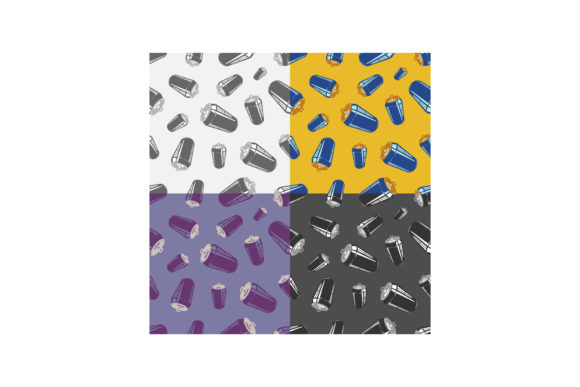
Seamless patterns with open aluminum can motifs are vector-based digital design assets—repeating, tileable graphics that feature stylized or realistic depictions of opened beverage cans (typically soda or energy drink cans), often rendered in clean, minimalist, or industrial aesthetics. These aren’t photographs or isolated clipart; they’re professionally crafted vector patterns, meaning they scale infinitely without pixelation and integrate smoothly into design workflows. The “open” detail—showing the pulled tab, exposed interior rim, or slight tilt revealing the top edge—is key. It adds narrative, texture, and visual interest while reinforcing themes of refreshment, modern consumption, urban culture, or sustainable reuse.
Why “Seamless” Matters
A seamless pattern repeats perfectly edge-to-edge—no visible seams, gaps, or misalignments when tiled across a surface. This is essential for practical applications like fabric printing, wallpaper, packaging backgrounds, or web UI textures. Unlike static images, seamless vector patterns adapt fluidly to any dimension: a 10-inch swatch for textile sampling or a 10-foot banner for retail display. Because they’re built in vector format (commonly SVG, EPS, or AI), designers retain full editability—adjusting colors, spacing, or even modifying individual can shapes without quality loss.
Purpose & Practical Relevance
These patterns serve dual roles: as expressive ornamental elements and functional design systems. In fashion and home textiles, they lend contemporary edge—think sporty lounge sets, festival totes, or café aprons where pop-culture references resonate with younger audiences. In branding and packaging, they subtly reinforce product identity (e.g., a craft soda brand using its own can silhouette in a repeating background on labels or merch). Even in digital spaces—like app loading screens or social media templates—they offer recognizable, scalable texture that feels both playful and polished.
Real-World Use Cases
- Fashion Designers: Printing on cotton jersey for limited-edition streetwear hoodies—where the open-can motif echoes urban authenticity and casual energy.
- Interior Stylists: Applying the pattern to upholstery fabric for bar stools or cushion covers in a retro-futuristic café, blending nostalgia with modern minimalism.
- Print-on-Demand Sellers: Integrating the vector pattern into POD platforms (like Spoonflower or Printful) to launch customizable phone cases, tote bags, or wall art—no inventory risk, just scalable creativity.
- Educational Tools: Design instructors use these files to teach students about repeat construction, color theory in context, and vector path manipulation—all through an accessible, relatable subject.
How These Patterns Fit Into Modern Creativity & Business
In today’s visual economy, differentiation hinges on authenticity *and* efficiency. Seamless aluminum can patterns meet both needs. They’re not generic “food” or “beverage” icons—they carry subtle cultural coding: accessibility, informality, sustainability (especially when styled with recycled-metal textures or matte finishes), and even irony (juxtaposing mass-produced objects with handcrafted-looking repeats). For small businesses, licensing or purchasing such vectors is far more cost-effective—and legally safer—than commissioning custom illustrations from scratch.
Technologically, their vector nature aligns with industry standards. Designers import them directly into Adobe Illustrator, Affinity Designer, or Figma. Developers embed SVG versions responsively in websites. Print providers accept high-res PDF exports with CMYK-ready color profiles—ensuring consistency from screen to silk-screened fabric or dye-sublimated polyester.
Clarifying Common Misconceptions
Misconception #1: “Open aluminum can = only for beverage brands.”
Not at all. While relevant to FMCG marketing, these patterns thrive in abstract contexts too—used monochromatically for texture, rotated 45° for rhythm, or layered with halftones for vintage poster effects. Their strength lies in form, not literal function.
Misconception #2: “Seamless means ‘boring repetition.’”
Far from it. Sophisticated seamless patterns use intentional variation: alternating can angles, subtle size shifts, overlapping shadows, or staggered rows. The best examples mimic organic rhythm—not robotic duplication—making them feel alive, not mechanical.
Misconception #3: “Vector = automatically print-ready.”
While vectors are ideal, readiness depends on preparation. Always verify that the file includes outlined fonts (if text is present), embedded color profiles (Pantone/CMYK for print, sRGB for web), and proper bleed/margin settings for fabric printing. Reputable marketplaces (like Creative Market or Envato Elements) provide usage guidelines—but due diligence remains the designer’s responsibility.
Design Principles Behind Effective Aluminum Can Patterns
Great seamless patterns balance three core elements: rhythm, contrast, and contextual harmony.
- Rhythm: Achieved through consistent spacing, directional flow (e.g., cans tilting upward to suggest energy), or alternating light/dark variants—guiding the eye naturally across the surface.
- Contrast: Not just tonal, but conceptual—pairing sleek metallic sheen with matte fabric backdrops, or placing crisp vector lines against organic hand-drawn textures in hybrid designs.
- Contextual Harmony: Ensuring the pattern’s tone matches its application. A distressed, grunge-style open-can repeat suits a punk band T-shirt; a geometric, line-art version fits a tech startup’s conference lanyard.
Choosing the Right Pattern for Your Project
Ask yourself three questions before downloading or commissioning:
- What’s the substrate? Cotton absorbs ink differently than polyester—choose patterns with appropriate density (e.g., lighter repeats for dark fabrics to avoid muddiness).
- What’s the scale? A tiny 1-inch repeat overwhelms a large drape; a bold 6-inch repeat loses impact on a wristband. Preview tiles at actual output size.
- What’s the message? Playful? Industrial? Eco-conscious? Match stylistic cues—glossy gradients suggest premium drinks; brushed aluminum textures evoke sustainability; flat-color versions support brand simplicity.
Why This Niche Design Element Endures
Aluminum cans are quietly iconic: lightweight, infinitely recyclable, globally recognized. By transforming them into ornamental vectors, designers tap into shared visual literacy while elevating the mundane into art. Unlike fleeting trends, this motif bridges generations—nostalgic for Gen X, ironic for Millennials, aestheticized for Gen Z. Its versatility across mediums (fabric, paper, screen, even 3D-printed surfaces) ensures longevity.
Moreover, it reflects broader creative values: resourcefulness (repurposing everyday objects as art), clarity (vector precision), and intentionality (every curve, shadow, and gap serves the repeat logic). In education, it’s a gateway to understanding pattern mathematics; in business, it’s a low-barrier entry into branded visual language; in personal projects, it’s joyful self-expression—with zero need for illustration skills.
Getting Started Responsibly
If you’re new to using seamless vector patterns:
- Start with royalty-free marketplaces that specify commercial licenses—confirming rights for physical products and resale.
- Use free vector editors like Inkscape to experiment with recoloring or resizing before committing to paid assets.
- When printing on fabric, request a physical swatch first—digital previews rarely capture how metallic tones or fine lines render on textured weaves.
Whether you’re launching a capsule collection, designing a pop-up shop interior, or exploring vector fundamentals, seamless patterns with open aluminum can motifs offer more than decoration. They’re a thoughtful fusion of cultural resonance, technical precision, and adaptable beauty—proof that meaningful design often begins with looking closely at the ordinary.