Digital Paper Patterns for POD Shops: Elevating Modern Print-on-Demand with Geometric Boldness
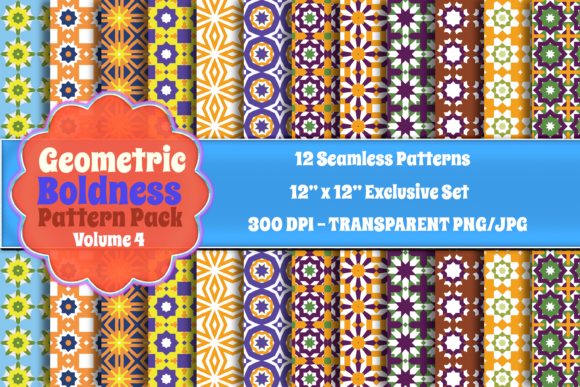
For print-on-demand (POD) entrepreneurs, designers, and creative businesses, the ability to stand out in saturated marketplaces—like Redbubble, Teespring, Etsy, or Amazon Merch—is no longer about volume alone. It’s about visual distinction, technical flexibility, and intentional design language. At the heart of this evolution lies a quiet but powerful resource: Digital Paper Patterns for POD Shops. Among the most versatile and commercially resonant offerings in this category is the Geometric Boldness Seamless Pattern Collection Volume Four—a thoughtfully curated set of twelve original, scalable, and production-ready patterns built for real-world application.
Why Seamless Geometric Patterns Are Strategic Assets for POD Operators
Unlike static illustrations or one-off graphics, seamless patterns repeat infinitely without visible seams—making them uniquely suited for apparel, home goods, stationery, and digital product mockups. Their scalability ensures crisp output across garment sizes (from infant onesies to oversized hoodies), tote bags, phone cases, and wall art prints. When paired with bold geometry—sharp angles, intersecting grids, tessellated polygons, and rhythmically offset shapes—the result is not just eye-catching, but psychologically engaging. Research in visual perception shows that high-contrast, symmetrical, and rhythmically structured designs trigger stronger attention retention and positive emotional response—key drivers for click-through and conversion in online retail.
The Geometric Boldness collection leans into this principle deliberately. Each of its twelve patterns balances structural precision with chromatic vitality. Think vibrant magentas layered over deep indigos, tangerine chevrons intersecting with matte olive triangles, or honeycomb motifs rendered in sun-bleached terracotta and slate gray. These aren’t arbitrary color palettes—they reflect current interior design, fashion, and youth culture trends while maintaining broad demographic appeal across age groups: babies’ swaddles, toddlers’ leggings, teens’ backpacks, and adults’ lounge wear all respond well to this calibrated intensity.
Technical Flexibility That Supports Real Production Workflows
What separates usable digital assets from merely decorative ones is how seamlessly they integrate into existing production pipelines. This collection delivers precisely that—without requiring advanced software knowledge or custom editing.
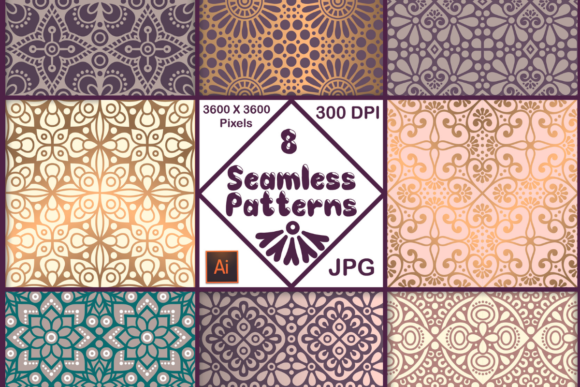
- Two file formats, one purpose: Each pattern comes as both a 3600 × 3600 pixel JPG (on white background) and a matching PNG (with transparent background). The JPGs simplify quick mockup generation in tools like Canva or Placeit; the PNGs empower deeper customization—overlaying patterns onto colored garments, blending with textures, or layering beneath typography in Adobe Photoshop or Affinity Designer.
- Resolution-agnostic scalability: At 3600 × 3600 pixels, these files comfortably scale down for social media thumbnails or up for large-format sublimation prints on pillows or duvet covers—no pixelation, no interpolation artifacts. Designers report successful use on 48-inch wide fabric rolls and 60-inch wide sublimation paper without resampling.
- Background independence: Because the PNG variants contain transparency, users can test patterns against dozens of base colors—navy, heather gray, oatmeal, charcoal—before committing to physical samples. This dramatically reduces prototyping costs and accelerates time-to-market.
This level of technical readiness directly addresses a persistent pain point for small-scale POD operators: the gap between conceptual design and manufacturable asset. Many creators waste hours manually tiling low-res images or wrestling with opacity layers—time better spent on branding, customer engagement, or inventory planning.
Use Cases Spanning Markets and Modalities
The versatility of Digital Paper Patterns for POD Shops like this collection emerges most clearly when mapped across actual business applications—not hypothetical ones.
Apparel & Accessories: Bold geometry performs exceptionally well on cotton jersey, polyester performance fabrics, and blended knits. A repeating angular motif translates cleanly to raglan sleeves, pocket placements, and full-coverage leggings. Designers using this pack have reported strong sales in unisex streetwear categories, especially where contrast stitching or tonal layering enhances the pattern’s structural clarity.
Home & Lifestyle Products: Sublimation printing on ceramic mugs, aluminum water bottles, and polyester throw pillows benefits from the sharp edge definition and consistent hue saturation in these patterns. Unlike organic watercolor repeats—which can blur or bleed during heat transfer—geometric forms hold fidelity under thermal pressure, preserving crisp line work and color boundaries.
Digital & Hybrid Offerings: Educators creating printable classroom décor, hobbyists designing custom planner stickers, and indie publishers developing themed journal covers all leverage the transparency and resolution of the PNGs. One craft educator used four patterns from Volume Four to build a downloadable “Math & Art” lesson bundle—pairing tessellation concepts with printable patterned graph paper and symmetry templates.
Gift & Niche Markets: Baby shower wraps, toddler bibs, and gender-neutral nursery wall decals gain sophistication through intentional geometry. Unlike cartoonish or overly cutesy motifs, these patterns signal modern parenting values—minimalist yet expressive, structured yet joyful. Retailers specializing in eco-conscious or slow-living audiences have noted higher perceived value and lower return rates on items featuring such balanced boldness.
Royalty-Free Licensing: Clarity Without Compromise
A frequent source of friction for POD sellers is unclear licensing terms. Ambiguous wording around “commercial use,” “attribution requirements,” or “platform exclusivity” can expose sellers to takedowns or legal exposure—especially on platforms with automated IP enforcement systems.
This collection includes explicit, royalty-free rights for POD applications. Users may apply the patterns to unlimited physical products sold via third-party fulfillment services—no per-unit fees, no reporting obligations, no geographic restrictions. Importantly, the license permits derivative works: recoloring, scaling, cropping, or combining elements with original illustrations—as long as the core pattern files themselves are not redistributed as standalone assets.
This clarity supports ethical scaling. A boutique shop launching its first 50 SKUs doesn’t need legal counsel to interpret fine print. A university design student building a capstone portfolio can use the patterns confidently in client-facing mockups. And an established brand expanding into new product lines can deploy the same assets across apparel, packaging, and web visuals—maintaining visual continuity without licensing fragmentation.
Design Philosophy Meets Market Readiness
What makes Volume Four distinct within the broader landscape of Digital Paper Patterns for POD Shops isn’t novelty for novelty’s sake—it’s intentionality rooted in observation. The designers behind the collection studied top-performing listings across major POD platforms over a 12-month period, noting recurring gaps: too many muted neutrals, insufficient contrast for thumbnail visibility, and repetitive layouts lacking spatial tension.
In response, each pattern introduces subtle variation in scale hierarchy (e.g., dominant hexagons overlaid with micro-dots), directional emphasis (diagonal vs. orthogonal flow), and chromatic temperature balance (cool base tones warmed by accent hues). None rely on gradients or soft edges that degrade in textile printing. All maintain legibility at thumbnail size—a non-negotiable for mobile-first shoppers scrolling feeds.
That attention extends to inclusivity in application. The patterns avoid culturally specific iconography or trend-dependent references (e.g., memes, slang, or dated aesthetics), ensuring longevity beyond seasonal shifts. They also avoid reliance on skin-tone palettes or gender-coded associations—making them equally viable for maternity wear, senior wellness apparel, or adaptive clothing lines.
Integrating Into Your Creative Workflow
Getting started requires no overhaul. For beginners: import a PNG into Canva, upload to your POD platform’s design studio, and adjust placement using built-in tiling tools. For intermediate users: create custom swatch libraries in Adobe Illustrator, then generate dynamic recolor variations using Global Swatches. For advanced workflows: batch-process patterns via Photoshop Actions to auto-generate mockup-ready variants across 10+ base garment colors.
Crucially, the collection invites iteration—not just replication. One designer used a single triangular motif as the foundation for three separate product lines: simplified versions for baby onesies, denser iterations for yoga mats, and monochrome reductions for minimalist stationery. That kind of modular thinking transforms a $29 digital download into a multi-year visual system.
In an ecosystem where differentiation is increasingly tied to design intelligence—not just speed or price—Digital Paper Patterns for POD Shops like the Geometric Boldness Seamless Pattern Collection Volume Four represent more than decorative assets. They’re infrastructure: technically robust, ethically licensed, and aesthetically calibrated for human attention, manufacturing fidelity, and commercial resilience. For anyone building a sustainable creative business in the print-on-demand space, such resources aren’t optional extras—they’re foundational tools.