Why Seamless Kitchen Patterns Are Reshaping Visual Design Workflows for Creative Professionals
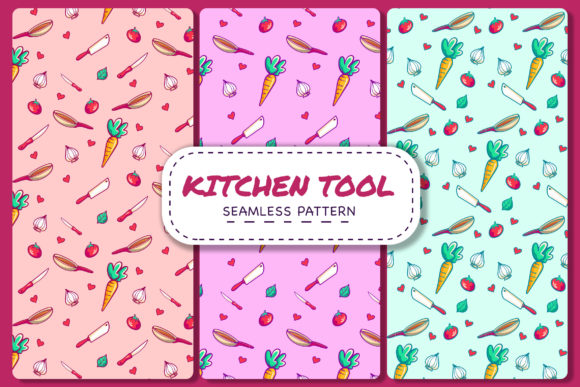
In today’s fast-paced creative economy, efficiency and authenticity are no longer competing priorities—they’re interdependent. Designers, marketers, product developers, and content creators increasingly rely on assets that bridge aesthetic intention with technical precision. Among the most quietly transformative tools gaining traction across studios and agencies is 3 Kitchen Set - Seamless Patterns: a curated, production-ready collection of repeatable surface designs rooted in functional domestic aesthetics.
Unlike generic texture packs or abstract tile sets, 3 Kitchen Set - Seamless Patterns delivers cohesion through context-aware design—featuring stylized yet grounded interpretations of kitchen surfaces: ceramic tile motifs, brushed stainless steel grain, and matte laminate woodgrain—all engineered as true seamless repeats. Each pattern maintains visual integrity at any scale, from social media banners to large-format retail signage, without visible seams, distortion, or tiling artifacts.
More Than Decoration: A Response to Evolving Creative Expectations
The rise of 3 Kitchen Set - Seamless Patterns reflects deeper shifts in how professionals approach visual consistency, brand scalability, and cross-platform asset management. As digital experiences grow more immersive—and physical spaces increasingly double as branded touchpoints—the demand for design systems that extend meaningfully across surfaces has intensified.
Consider a food-tech startup launching a new line of smart kitchen appliances. Their marketing team needs cohesive visuals for Instagram carousels, e-commerce product pages, trade show backdrops, and packaging mockups—all within tight deadlines. Rather than commissioning custom illustrations for each use case or compromising quality with low-res stock tiles, they turn to 3 Kitchen Set - Seamless Patterns. The EPS CC and AI CC versions allow non-destructive editing in Adobe Illustrator—adjusting color palettes, scaling proportions, or isolating elements for layered compositing. JPEG and PNG variants enable rapid integration into Figma prototypes or CMS-driven landing pages.
This isn’t just about speed. It’s about maintaining tonal fidelity: a warm, artisanal woodgrain pattern used on a website hero image should feel like the same material rendered on a printed catalog spread—not a stylistic approximation, but a consistent tactile language.
Bridging Industry Trends with Practical Craft
Three converging trends make 3 Kitchen Set - Seamless Patterns especially relevant now:
- The Resurgence of Surface-First Design: Interior visualization, AR-powered home staging apps, and even AI-generated room renderings all depend on high-fidelity surface data. Designers no longer treat textures as afterthoughts; they’re foundational inputs. Seamless patterns with accurate lighting response (evident in the subtle highlights of the stainless steel variant) support photorealistic rendering pipelines without requiring custom UV mapping.
- Modular Brand Systems: Forward-looking brands build identity systems that adapt—not just resize. A modular pattern library like 3 Kitchen Set - Seamless Patterns allows teams to establish visual rhythm across disparate touchpoints while preserving brand warmth and familiarity. For example, a sustainable cookware brand might pair the ceramic tile pattern with hand-drawn iconography, reinforcing craft values without visual clutter.
- Collaborative Production Environments: With remote collaboration standard practice, file interoperability is non-negotiable. The inclusion of EPS CC, AI CC, JPEG, and PNG formats ensures compatibility across Adobe Creative Cloud workflows, open-source vector editors, and web-native design tools. No one needs to convert files mid-project—or worse, recreate them manually.
What distinguishes 3 Kitchen Set - Seamless Patterns from broader “kitchen-themed” graphics is its intentional restraint. There are no cartoonish utensils, no forced typography overlays, no seasonal clichés. Instead, it offers distilled visual essences—clean lines, balanced contrast, calibrated saturation—that serve as neutral yet expressive foundations. This aligns with the growing preference among professionals for enabling assets, not decorative distractions.
Workflow Integration: Where Theory Meets Execution
Real-world adoption reveals how 3 Kitchen Set - Seamless Patterns integrates into daily practice—not as a standalone download, but as infrastructure.
A freelance UX designer building a recipe app interface uses the matte laminate woodgrain pattern as a subtle background layer behind ingredient cards. Its low-contrast repetition avoids visual competition with text while adding depth and warmth—critical for an app targeting health-conscious users seeking calm, intentional interactions.
An architectural visualization studio incorporates the ceramic tile pattern into a kitchen renovation proposal. Because the pattern is truly seamless and built with vector precision, they can map it accurately onto 3D models using UV coordinates—no stretching, no pixelation—even when zooming into a 4K render of grout lines.
A boutique food brand launching limited-edition packaging applies the stainless steel pattern to foil-stamped labels. The AI CC version allows precise adjustment of metallic sheen intensity to match physical foil specifications, ensuring digital mockups translate faithfully to print.
These aren’t edge cases. They reflect a normalization of cross-disciplinary fluency: designers thinking like material scientists, marketers understanding vector topology, entrepreneurs evaluating assets by their operational lifespan—not just first-use appeal.
Technical Rigor Meets Human-Centered Intent
The technical specifications of 3 Kitchen Set - Seamless Patterns FILE INCLUDED -EPS CC Version -AI CC Version -JPEG -PNG matter precisely because they support human-centered outcomes. EPS CC ensures backward compatibility with legacy Illustrator projects still maintained by enterprise marketing teams. AI CC enables live editing of gradients and blending modes—essential when adapting patterns to evolving brand guidelines. JPEG and PNG deliver immediate usability for presentations, client reviews, or rapid prototyping where vector fidelity isn’t required.
Crucially, none of these formats sacrifice artistic intent. The patterns retain their carefully calibrated balance of realism and abstraction—neither overly photographic nor excessively stylized. That balance allows them to function across contexts: as a background texture in a B2B SaaS dashboard illustrating smart kitchen integrations, or as a subtle watermark on a culinary school’s alumni newsletter.
Looking Ahead: Patterns as Strategic Assets
As generative tools accelerate, the value of thoughtfully authored, human-curated pattern libraries increases—not decreases. AI can replicate tiling, but it struggles with contextual coherence: knowing when a ceramic motif should suggest heritage craftsmanship versus minimalist modernity, or how stainless steel grain should respond to ambient light in a residential versus commercial setting.
3 Kitchen Set - Seamless Patterns represents a shift from treating design elements as disposable components to recognizing them as strategic assets—with measurable impact on time-to-market, brand recognition, and user engagement. Its relevance grows alongside trends like spatial computing interfaces, sustainable material storytelling, and hyperlocal retail experiences—all of which rely on consistent, credible surface language.
For professionals navigating tighter budgets, faster cycles, and higher expectations, this isn’t about finding shortcuts. It’s about investing in precision tools that amplify intention—not replace it. When every pixel serves both aesthetic and functional purpose, creativity becomes scalable. And when patterns carry narrative weight—evoking the quiet reliability of a well-designed kitchen—they do more than fill space. They invite trust.
That’s why 3 Kitchen Set - Seamless Patterns resonates beyond its literal subject matter. It’s a signal: in an era of noise, the most powerful design choices are often the most grounded, the most reusable, and the most respectfully crafted.