Rainbow Leopard Seamless Patterns
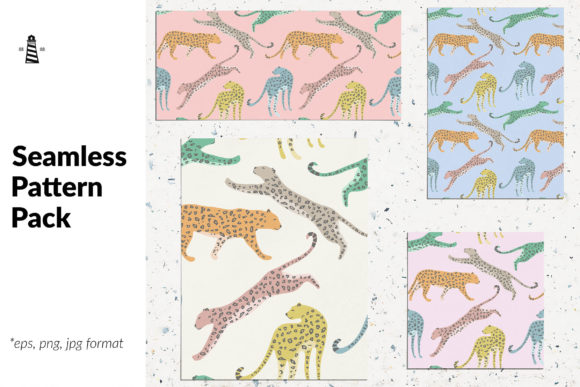
Seamless patterns remain a foundational asset in visual design—especially for professionals who need scalable, repeatable, and aesthetically cohesive backgrounds across print, digital, and product applications. Among recent releases, Rainbow Leopard Seamless Patterns stands out not for novelty alone, but for its deliberate execution: a tightly curated set of 100 hand-drawn vector patterns featuring stylized leopard motifs rendered in vibrant, harmonized color palettes. Unlike algorithmically generated or overly saturated “rainbow” assets, this collection balances expressive energy with structural discipline—making it unusually versatile for both commercial and editorial use.
What You Actually Receive—and Why It Matters
The package delivers 8 distinct pattern designs, each provided in four complementary formats: EPS (for broad compatibility with legacy and professional workflows), AI (native Illustrator files with editable layers and paths), JPG (high-resolution raster previews), and PNG (two transparent-background variants optimized for web overlays and mockups). All raster outputs are sized at 12 × 12 inches and rendered at 300 dpi—sufficient for large-format print such as fabric swatches, packaging prototypes, or wall graphics without upscaling artifacts.
This format diversity reflects thoughtful workflow integration. Designers using Adobe Creative Cloud can open AI files directly to adjust stroke weights, recolor individual elements, or isolate motif components. Print production teams benefit from EPS support in prepress pipelines. Marketers building social media templates or email headers can drop the PNGs into Canva or Figma without transparency issues. Even educators preparing classroom materials find the JPGs immediately usable in slide decks or printed handouts.
Quality Beyond Aesthetics: Hand-Drawn Precision and Vector Integrity
“Hand-drawn” is often used loosely—but here, it carries measurable weight. Each of the 100 vector art instances was crafted with deliberate linework, consistent pressure variation, and intentional negative space. The leopard spots aren’t uniform ellipses; they vary subtly in scale, edge softness, and placement density to avoid mechanical repetition. This nuance translates directly into real-world performance: when tiled across a full-page brochure background or stretched over a textile repeat, the pattern breathes rather than hypnotizes.
Vector fidelity is equally rigorous. Paths are clean, anchor counts are minimized without sacrificing detail, and no embedded raster effects compromise scalability. Tested across Illustrator versions CS6 through CC 2024, all AI files retain layer organization (e.g., “base motif,” “color overlay,” “texture pass”)—a practical advantage when adapting colors to brand guidelines or isolating elements for animation storyboards.
Practical Flexibility Across Use Cases
Rainbow Leopard Seamless Patterns excels where adaptability meets intentionality. Consider these realistic applications:
- Product packaging for lifestyle brands: A wellness supplement line used one of the patterns as a die-cut window overlay on kraft boxes—its transparency-ready PNG allowed quick mockup iterations in Adobe Dimension before final print approval.
- Digital course materials: An online educator applied a muted variant (recoloring via Illustrator’s Recolor Artwork tool) to section dividers in a PDF workbook—maintaining visual rhythm without competing with text legibility.
- App interface elements: A fintech startup incorporated a simplified version as a subtle animated background for their dashboard welcome screen—leveraging SVG export (derived from the AI file) to keep file size under 40 KB.
- Fabric and stationery design: A small-batch greeting card maker scaled one pattern to 24 × 24 inches and output to a DTG printer—no visible tiling seams, even at close inspection.
Crucially, none of these uses required third-party plugins, external texture libraries, or post-processing fixes. The assets performed as delivered—reducing iteration time and minimizing unexpected revisions during client feedback cycles.
Who Benefits Most—and Where It Fits (and Doesn’t Fit)
This collection serves professionals whose work demands both creative distinction and technical reliability. Freelance graphic designers building brand identities for boutique clients appreciate the balance of playfulness and polish. Small business owners launching merchandise lines value the print-ready specs and absence of licensing ambiguity. Educators and nonprofit communicators benefit from the immediate usability—no learning curve, no subscription dependencies.
It’s less suited for projects requiring photorealistic texture simulation (e.g., luxury leather visualization) or ultra-minimalist aesthetics where high-contrast patterning would overwhelm. Similarly, users needing hundreds of variations—or built-in color system mapping (like Pantone-anchored swatches)—will need supplemental tools. But within its scope, Rainbow Leopard Seamless Patterns avoids overpromising: it delivers what’s stated, consistently, without hidden constraints.
Long-Term Value and Integration Into Existing Workflows
Unlike trend-dependent assets that age quickly, these patterns derive longevity from two anchors: strong underlying structure and restrained chromatic logic. The rainbow palette isn’t arbitrary—it follows tonal progression principles, with adjacent hues sharing luminance values that prevent visual vibration when viewed at scale. That means a pattern used today on a summer campaign poster remains viable six months later in a holiday-themed email series, simply by adjusting saturation or applying a duotone overlay.
Version control is also straightforward. Because each design exists as discrete files—not a single monolithic library—teams can store, tag, and retrieve specific patterns via standard DAM systems or even basic cloud folders. No proprietary software or activation keys complicate archiving or team handoff.
Realistic Considerations and Recommendations
One limitation worth noting: while the 8 core designs offer variety, they don’t include distressed, metallic, or gradient-based variants. Users seeking those treatments will need to apply them manually—a reasonable expectation given the vector foundation, but something to plan for early in a project timeline.
For best results, start with the AI files when color adaptation is needed—Illustrator’s Global Colors and Recolor Artwork features let you shift entire palettes in seconds while preserving relative contrast. For web use, export PNGs at 72 dpi unless transparency is required; the included JPGs are already optimized for fast loading. And when preparing for fabric printing, verify repeat alignment using Illustrator’s Pattern Options panel—though all patterns tile cleanly by default, minor adjustments may be needed depending on the printer’s bleed requirements.
In practice, Rainbow Leopard Seamless Patterns functions less like a decorative add-on and more like a reliable component in a working toolkit—similar to a well-chosen typeface or a trusted stock photo library. Its strength lies not in flashiness, but in quiet consistency: delivering predictable quality, clear documentation, and tangible time savings across diverse professional contexts.